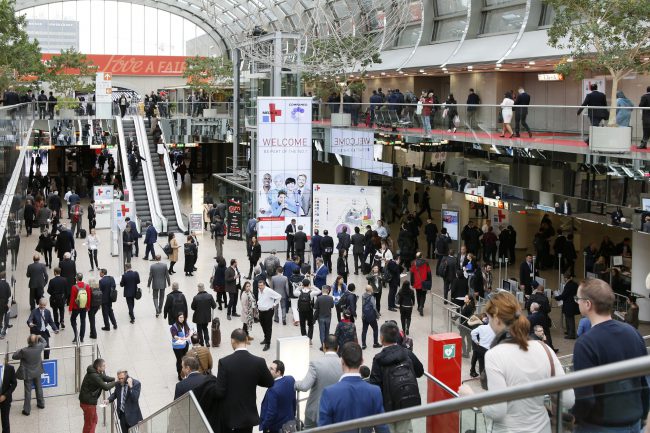
Compamed/Medica 2019
18-21 November 2019, Dusseldorf (Germany)| Compamed/Medica 2019



18-21 November 2019, Dusseldorf (Germany)| Compamed/Medica 2019
June 2019 | Project Status M18 During the first 18 months of the project, MOLOKO has completed the design of the overall layout of the photonic module and the assessment of the expected output signal of the optoplasmonic chip correlated to the different analytes of interest. The realization of the optoplasmonic chip is the next…

04 November 2019 MOLOKO project is on Fraunhofer FEP Newsletter. Read the newsletter HERE>>
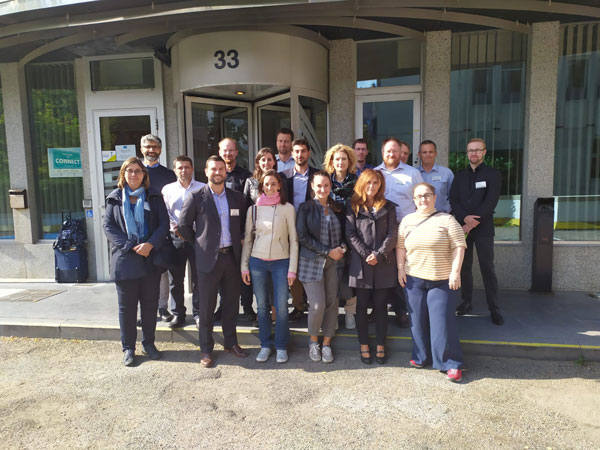
17-18 October 2019, Brussels (Belgium) | 2nd Review Meeting On the 17th and 18th of October 2019, the WP leaders met at DG Connect in Brussels (Belgium) for the 2nd Project Review meeting. Here’s some pictures of the event!
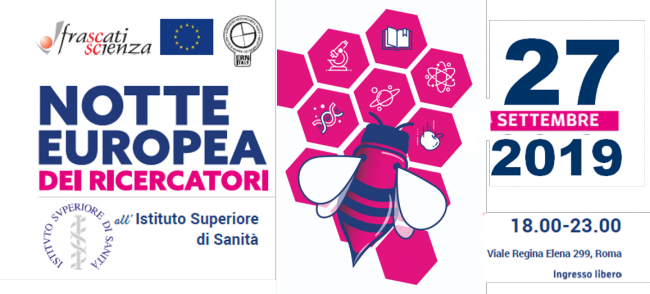
27 September 2019, Roma (Italy) | European Researchers’ Night 2019
26 June – 6 July 2019, Thessaloniky (Greece) | Nanotexnology 2019 NANOTEXNOLOGY explores the opportunities in the emerging fields of Nanotechnologies, Organic & Printed Electronics and Nanomedicine. NANOTEXNOLOGY brings together over 2,000 researchers, scientists, engineers, business, technical and policy professionals to promote research and industrial collaborations, identify priorities and strengthen the innovation ecosystem. This conference is…
1-4 July 2019, Thessaloniki (Greece) | 12th International Symposium on Flexible Organic Electronics (ISFOE19) ISFOE is the biggest scientific & technology event in Flexible Organic & Printed Electronics (OEs), that promotes the Research, Technology and Innovation in OE nanomaterials, Manufacturing Processes, Devices and Applications and Solutions. During ISFOE19 you will meet with other world-class scientists,…
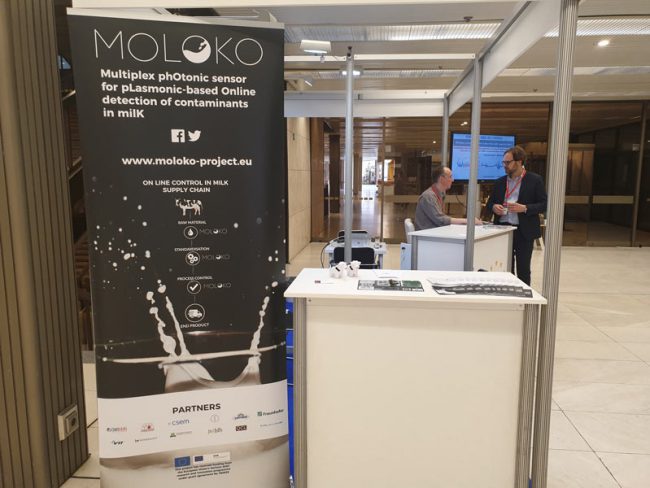
21-25 June 2019, Prague (Czech Republic) | IDF/ISO Analytical Week Mark Whatton from QCL participed to the ISO Analytical Event with a booth dedicated to the MOLOKO project to talk about our ongoing development of the Multiplex phOtonic sensor for pLasmonic-based Online detection of contaminants in milK.

27-31 May 2019, Nice (France) | European Materials Research Society Spring Meeting 2019 The 2019 Spring Meeting of the European Materials Research Society (E-MRS) was held from May 27 to 31, 2019, in Nice, France (Congress & Exhibition Centre Acropolis). It was the 37th of the series started in 1983. This event was organized in…
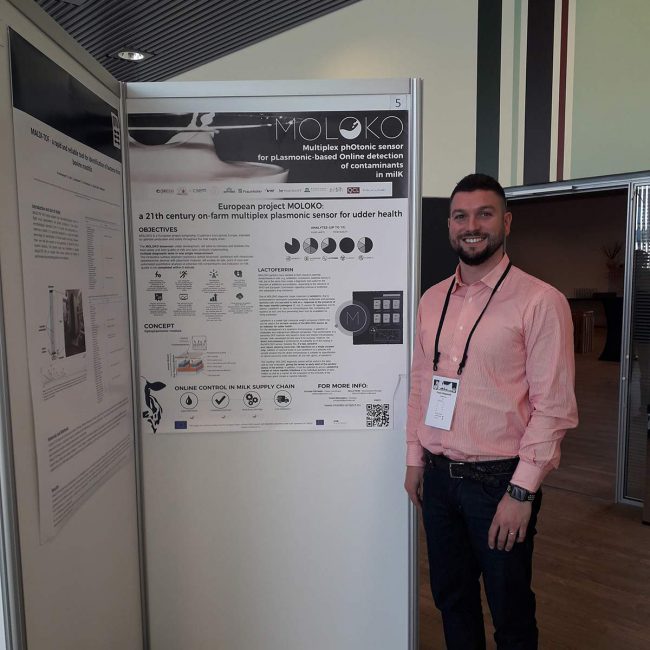
14-16 May 2019, Copenaghen (Denmark) | IDF Mastitis Conference 2019 In this 4 days conference on mastitis, about 400 veterinarians from all the world were present to the most important international events regarding veterinarian decisions to fight mastitis. MOLOKO was presented by Dr. Bulgarelli from Parmalat, talking about relevant biomarkers and the effort to detect…
The early detection of contamination of food enabled by MOLOKO will increase food security, food safety, and the protection of health of consumers
Problem:
The consumption of staphylococcus enterotoxin which rapidly grows in milk is considered one of the most common forms of bacterial foodborne outbreaks worldwide. The health implications of these hazards make up the need for an effective detection system, such as MOLOKO sensor.
Solution:
Raw milk distributors will be mostly affected by MOLOKO, as they will be able to ensure highest quality at cheaper costs. Milk and dairy products account for 5% of all incriminated foods in staphylococcal outbreaks in Europe.
Problem:
During industrial milk treatment and processing, one major issue is the quality control of nutritional parameters.
Solution:
The dairy industry checks for different contaminants and residues, pathogens and adulterants. MOLOKO will allow to detect the presence of alterations of milk in a cost effective and simple manner, so that the adulterated milk can be discarded before it is inserted in the processing line.
Problem:
One major issue in bulk milk handling is linked to the transportation of contaminated milk. Bulk milk handling also causes high costs due to road transport of milk which does not meet quality standards, and thus will be discarded at processing sites.
Solution:
The use of MOLOKO sensor as handheld device by food operators allows for early detection of contaminated milk tanks (before they are combined in the tanker) or contaminated whole tanks (before they are transported to milk processing facilities).
Problem:
Most of the milk loss during production is due to dairy cow sickness, leading both to production of contaminated milk lots and the use of antibiotics to prevent and treat cow infections.
Solution:
MOLOKO will allow very early detection of contaminated milk by operating (i) directly on the milking machine by excluding automatically animals not suitable for milking and (ii) on batches of milk in order to isolate the single contaminated lots and prevent to spoil larger amounts of quality milk, thus leading to lower costs related to the production phase.