


Skip to content

  • Communication Kit
  • Private Area
Top Menu
Facebook page opens in new windowTwitter page opens in new windowYouTube page opens in new window
Search:
Moloko Project
Multiplex Photonic sensor for plasmonic-based online detection of contaminants in milk
Moloko ProjectMoloko Project
  • Home
  • Project
    • Objectives
    • Structure
    • Foreseen Impacts
    • Project Status
  • Partners
  • Media
    • News & Events
      • LOPEC 2022
    • Video
  • Publications
  • Contacts
  • Home
  • Project
    • Objectives
    • Structure
    • Foreseen Impacts
    • Project Status
  • Partners
  • Media
    • News & Events
      • LOPEC 2022
    • Video
  • Publications
  • Contacts

Daily Archives: 30 March 2022

You are here:
  1. Home
  2. 2022
  3. March
  4. 30

MOLOKO-sustainability-best-practice

MOLOKO project: a sensor for reducing waste

NewsBy Sara Attanà30 March 2022Leave a comment

MOLOKO project: a sensor for reducing waste 30 March 2022 We are proud to inform you that MOLOKO project has been taken as an example of best practice for companies to reduce waste, becoming more sustainable. Paolo Neri, Warrant Garden Project Coordinator, talked about the project in the video of 𝘙𝘦𝘥𝘶𝘤𝘦, the third R of…
MOLOKO-project-partners-at-LOPEC-2022

What’s happened at LOPEC 2022

Conferences, News, Past Events, Public EventsBy Sara Attanà30 March 2022Leave a comment

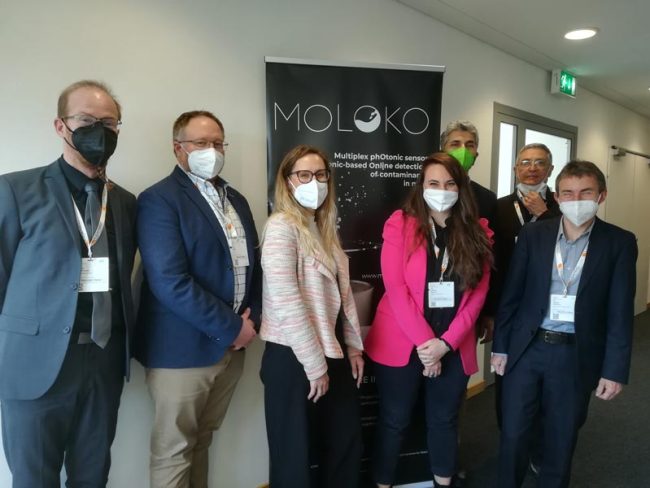
What’s happened at LOPEC 2022 We are very proud and honored having participated to LOPEC 2022 conference! More than 200 presentations from a total of 23 countries were held at the conference. LOPEC is once again the world’s leading communication platform for technology, solutions, knowledge and research in the printed electronics industry. In the various…

Moloko Project
Copyright 2018 MOLOKO - GA n. 780839 | All rights reserved

Powered by beWarrant S.L.

Go to Top
1. Production

Problem:

Most of the milk loss during production is due to dairy cow sickness, leading both to production of contaminated milk lots and the use of antibiotics to prevent and treat cow infections.

Solution:

MOLOKO will allow very early detection of contaminated milk by operating (i) directly on the milking machine by excluding automatically animals not suitable for milking and (ii) on batches of milk in order to isolate the single contaminated lots and prevent to spoil larger amounts of quality milk, thus leading to lower costs related to the production phase.

5. Consumption

The early detection of contamination of food enabled by MOLOKO will increase food security, food safety, and the protection of health of consumers

4. Distribution

Problem:

The consumption of staphylococcus enterotoxin which rapidly grows in milk is considered one of the most common forms of bacterial foodborne outbreaks worldwide. The health implications of these hazards make up the need for an effective detection system, such as MOLOKO sensor.

Solution:

Raw milk distributors will be mostly affected by MOLOKO, as they will be able to ensure highest quality at cheaper costs. Milk and dairy products account for 5% of all incriminated foods in staphylococcal outbreaks in Europe.

3. Processing

Problem:

During industrial milk treatment and processing, one major issue is the quality control of nutritional parameters.

Solution:

The dairy industry checks for different contaminants and residues, pathogens and adulterants. MOLOKO will allow to detect the presence of alterations of milk in a cost effective and simple manner, so that the adulterated milk can be discarded before it is inserted in the processing line.

2. Bulk Milk handling and logistics

Problem:

One major issue in bulk milk handling is linked to the transportation of contaminated milk. Bulk milk handling also causes high costs due to road transport of milk which does not meet quality standards, and thus will be discarded at processing sites.

Solution:

The use of MOLOKO sensor as handheld device by food operators allows for early detection of contaminated milk tanks (before they are combined in the tanker) or contaminated whole tanks (before they are transported to milk processing facilities).